
Through its six meetings over three years, the Executive Session set out to both develop and answer questions that U.S. state courts will face in the foreseeable future, attempting to clarify what leaders of state courts can and should do to distinguish their role in our system of democratic governance.
The Executive Session for State Court Leaders in the 21st Century was funded by the Bureau of Justice Assistance, the State Justice Institute, and the National Center for State Courts.
David B. Rottman, Ph.D., a Principal Court Research Consultant at the National Center for State Courts, discusses the Harvard Executive Session.
What are the Harvard Executive Sessions?
The Executive Sessions at the Harvard Kennedy School bring together individuals of independent standing who take joint responsibility for rethinking and improving society's responses to an issue.
Members of the Executive Session for State Court Leaders in the 21st Century explored a broad array of themes, including
- the use of budget crises as adaptive challenges to court leaders,
- identification of essential principles for effective court governance,
- the tension between problem solving and decision making,
- the challenges social media pose to court legitimacy,
- how courts defend themselves from political attack,
- and the notion of chief justices as civic leaders.
Many topics were developed by members into papers that are being published in a series by NCSC and posted on this page.
Harvard Executive Session papers:
- "The Politics of Restraint"
- "Sustainable Court Governance: The Critical Role of Strategic Management"
- "Governance: The Final Frontier"
- "Cross-Branch Collaboration: What Can We Learn from the Collaboration Between Courts and the Division of Youth Services in Missouri?"
- "Keeping Courts Funded: Recommendations on How Courts can Avoid the Budget Axe"
- "Courts are Conversations: An Argument for Increased Engagement by Court Leaders"
- "Juror and Jury Use of New Media: A Baseline Exploration"
- "Opinions as the Voice the Court: How State Supreme Courts Can Communicate Effectively and Promote Procedural Fairness"
- "A Case for Court Governance Principles"
- "Herding Lions: Shared Leadership of State Trial Courts"
More resources
Since 1981, the State Justice Institute and Bureau of Justice Assistance have sponsored a series of symposia, hosted by the NCSC, to reflect upon the progress and anticipate the challenges of administering and managing state courts.
Publications, presentations and video of the sessions from the 4th National Symposium on Court Management in 2010 can be found here.
Members
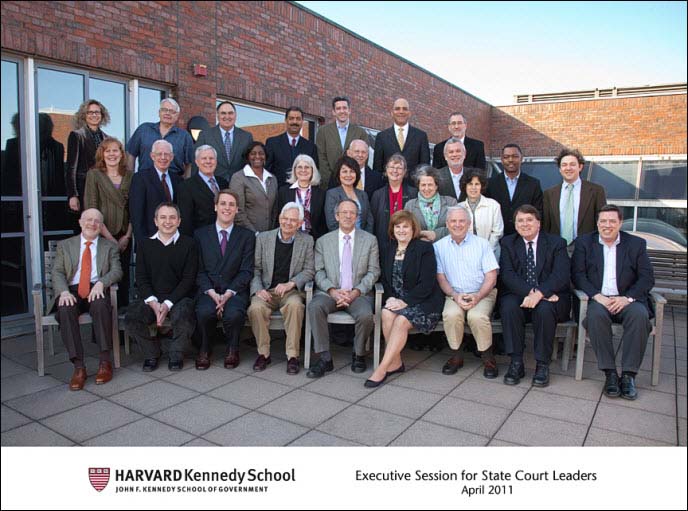
Photo: Martha Stewart
Top row, left to right:
Marea Beeman, Senior Research Associate, Harvard Kennedy School Program in Criminal Justice Policy and Management
Judge Michael Trickey, King County Superior Court (Seattle, Wash.)
Chief Justice Paul DeMuniz, Supreme Court of Oregon
Chief Judge Eric Washington, District of Columbia Court of Appeals
Greg Rowe, Chief of Legislation and Policy Unit, Philadelphia District Attorney's Office
Chief Justice Wallace Jefferson, Supreme Court of Texas
Daniel Becker, State Court Administrator, Utah Administrative Office of the Courts
Middle row:
Christine Cole, Executive Director of the Program in Criminal Justice Policy and Management
Judge John Cleland, Superior Court of Pennsylvania
William Vickrey, Administrative Director, California Administrative Office of the Courts
Rosalyn Frierson, State Court Administrator, South Carolina Judicial Department
Julie Boatright Wilson, Harry Kahn Senior Lecturer in Social Policy, Harvard Kennedy School
Presiding Judge Barbara Rodriguez Mundell, Superior Court of Arizona, Maricopa County, Retired
Thomas Gottschalk, Of Counsel at Kirkland & Ellis
Chief Justice Christine Durham, Supreme Court of Utah
Vicki Jackson, Carmack Waterhouse Professor of Constitutional Law, Georgetown University Law Center
Michael Bridenback, Trial Court Administrator, Thirteenth Judicial Circuit (Tampa, Fla.)
Judith Resnik, Arthur Liman Professor of Law, Yale Law School
Russell Brown, Court Administrator, Cleveland Municipal Court
Jed Shugerman, Assistant Professor of Law, Harvard Law School
Seated:
David Rottman, Principal Court Research Consultant, National Center for State Courts
David Barron, Professor of Law, Harvard Law School
Garrett Graff, Editor-in-Chief, Washingtonian Magazine
Chief Justice Jeff Amestoy, Fellow, Harvard Kennedy School; Vermont Supreme Court, Retired
Christopher Stone, Guggenheim Professor of the Practice of Criminal Justice, Harvard Kennedy School
Mary McQueen, President, National Center for State Courts
Ted Eisenberg, Henry Allen Mark Professor of Law, Cornell Law School
Chief Justice Randall Shepard, Supreme Court of Indiana
Chief Justice James Hannah, Arkansas Supreme Court
Not pictured:
Chief Justice Margaret Marshall, Supreme Judicial Court of Massachusetts, Retired
Senator Mee Moua, Vice President for Strategic Impact Initiatives, Asian & Pacific Islander American Health Forum (APIAHF); Senator, Minnesota Senate, Retired