


Early data signals increased civil filings, decreased clearance rates in 2025
Early 2025 caseload data reveal a continuing shift in the composition of state court workloads.
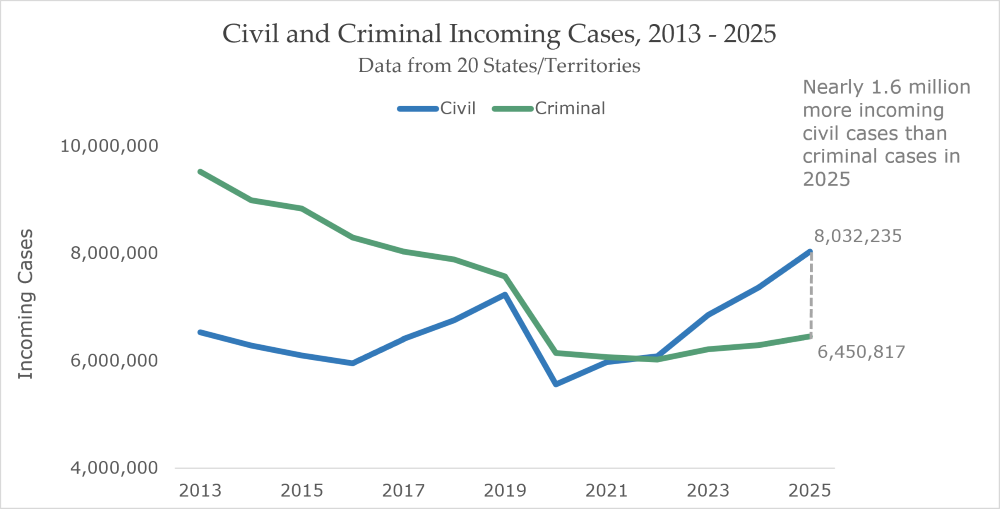
For the fourth consecutive year, civil filings are growing faster than criminal filings, widening a trend that first emerged as courts recovered from pandemic-era disruptions. At the same time, courts may be seeing the first signs of a slowing post-pandemic recovery, as clearance rates decline after several years of improvement.
While total filings continue to evolve, the most notable story emerging from early 2025 data is not simply that civil caseloads are increasing. Rather, the growth is concentrated within specific types of cases, particularly contract disputes, small claims matters, and debt collection-related litigation. These case categories now account for much of the growth observed across participating states.
These findings are based on preliminary data reported by about 20 states and territories submitted through the Court Statistics Project (CSP), a collaborative initiative of NCSC and the Conference of State Court Administrators (COSCA). Complete 2025 caseload reporting is expected by September 1.
A continuing shift in court workloads
Over the past several years, state courts have experienced a gradual but significant change in the balance of incoming cases. Criminal filings, which historically represented a dominant share of court activity, have recovered more slowly following pandemic disruptions. Civil filings, meanwhile, have expanded steadily.
Early 2025 data suggest that this shift is continuing.
Figure 1

View larger image. States reporting: AK, AZ, CA, CT, DE, FL, KY, LA, ME, MA, MN, NE, NH, NM, MP, OH, PA, RI, TX, WI.
The gap between incoming civil and criminal cases has widened each year since 2022. Civil cases now account for an increasingly larger share of total court business compared to criminal matters.
This trend reflects more than simple changes in filing volume. It represents a fundamental shift in the nature of work entering state courts. As civil caseloads grow, courts may face increasing demands in managing large volumes of debt-collection actions and other financially driven disputes.
For court leaders and policymakers, understanding not only whether caseloads are growing but also what kinds of cases are driving that growth is critical for workforce planning, technology investments, and case management strategies.
The backlog recovery story may be changing
Since 2021, courts across the country have devoted considerable effort toward resolving pandemic-era backlogs. Enhanced case management practices, expanded hearing options, and operational innovations helped many state court jurisdictions process cases faster than they were receiving them.
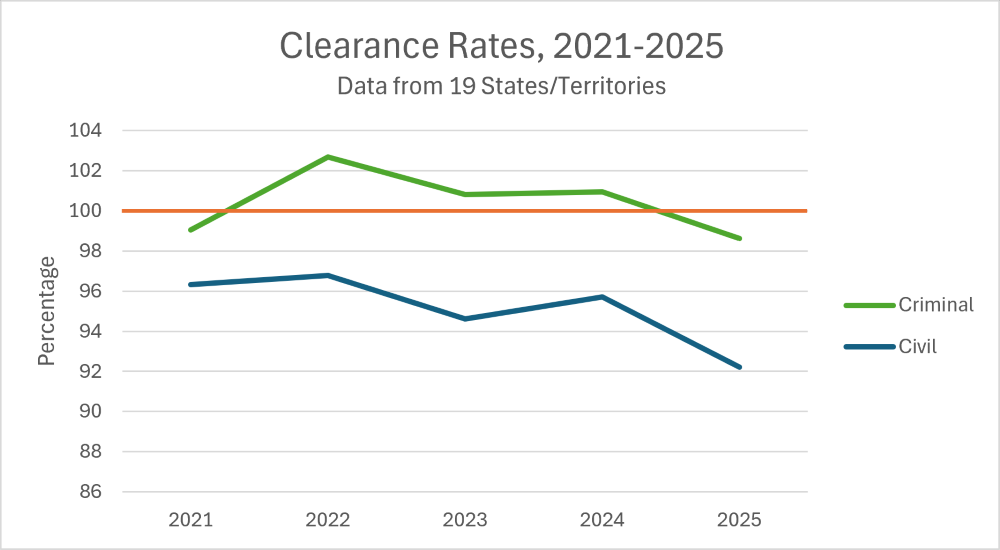
Early 2025 data suggest that this recovery phase may be entering a new stage. As civil caseloads continue to grow and exceed criminal filings, declining clearance rates could signal mounting strain on court capacity.
Figure 2

View a larger image. States reporting: AK, AZ, CA, CT, DE, FL, KY, MN, NE, ND, NH, NM, OH, PA, RI, TX, VT, WI.
As filing activity increases, particularly in civil matters, clearance rates appear to be declining. Although courts continue to dispose of large volumes of cases, the recent decline in clearance rates could indicate that incoming workloads are outpacing court processing capacity.
This does not necessarily signal a return to pandemic-level backlogs. However, it may represent an early warning sign that the gains achieved during the recovery period are becoming more difficult to sustain as case volumes grow.
If current trends continue, courts could face renewed pressure on staffing, judicial resources, and case processing timelines. Monitoring clearance rates will be important to determine whether the declines observed in early reporting states represent temporary fluctuations or the beginning of a broader national trend.
Civil growth is concentrated in financial & collection-related litigation
At first glance, growing civil caseloads might suggest broad increases across many types of litigation. The early data tell a different story.
The growth in civil filings is concentrated within a relatively small number of case categories.
Four major case types account for approximately 80 percent of reported civil filings:
- Contract
- Small claims
- Tort
- Real property
Of these categories, contract and small claims filings account for nearly all recent growth.
Figure 3

View a larger image. States reporting: AK, AZ, CT, DE, KY, ME, MA, MN, NE, NH, MP, ND, PR, RI, TX, VT, WI.
Contract filings increased from approximately 762,000 cases in 2021 to more than 1.3 million in 2025 across reporting jurisdictions. Small claims filings also experienced substantial increases, rising from approximately 671,000 in 2021 to nearly 1 million in 2025.
By comparison, tort and real property filings have remained relatively stable, growing modestly over the same period.
The concentration of growth in contract and small claims categories suggests that courts are not experiencing a broad expansion of civil litigation. Instead, the increase appears to be driven by disputes involving financial obligations, debt recovery, collections activity, and other lower-dollar claims.
This distinction matters. Different case types place different demands on court operations. A surge in contract and small claims filings may require courts to devote resources to high-volume case processing, online filing systems, case automation tools, and self-service assistance rather than the resource-intensive case management often associated with complex civil litigation.
Beneath the contract case numbers
The contract category provides perhaps the clearest illustration of what is driving civil growth.
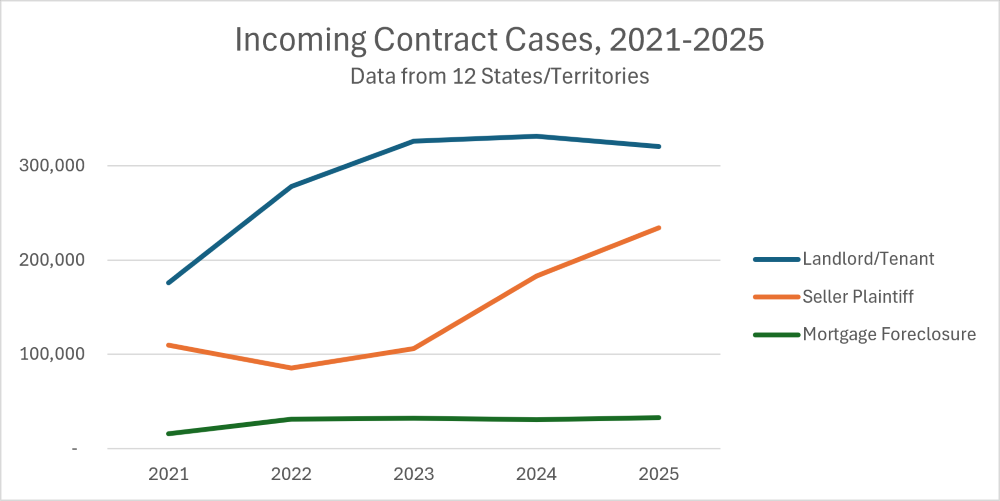
While landlord-tenant cases remain the largest contract-related filing category, seller-plaintiff cases have experienced the most dramatic recent growth.
Figure 4

View a larger image. Reporting states: AK, AZ, CT, DE, ME, MA, NH, MP, PA, PR, RI, VT.
Seller-plaintiff filings increased from approximately 86,000 cases in 2022 to more than 234,000 cases in early 2025. This category typically includes debt collection and creditor actions and has become one of the fastest-growing segments of civil court activity.
Landlord-tenant filings rose sharply following the pandemic and remain elevated, although early 2025 data suggest growth may be stabilizing. Mortgage foreclosure filings have also increased since 2021, but remain comparatively modest in volume.
Taken together with the rapid growth in small claims filings, these patterns point toward a common theme: financial and collection-related disputes appear to be driving much of the observed increase in civil caseloads.
The emerging caseload profile is therefore less a story about expanding civil litigation generally and more a story about increasing demand for courts as venues for resolving consumer debt, collection actions, and other financially motivated claims.
Understanding these dynamics will be increasingly important for courts considering procedural reforms, technology investments, and access-to-justice initiatives.
Looking ahead
The findings presented here are based on data from approximately 20 states and territories and should be interpreted as preliminary indicators rather than final national trends. Nevertheless, several themes are already emerging.
First, the long-observed shift toward larger civil caseloads continues to gain momentum. Second, courts may be approaching a turning point in their post-pandemic recovery efforts as clearance rates decline. Finally, the growth in civil dockets is concentrated in financially driven case categories, particularly contract disputes, debt collection actions, and small claims matters.
The Court Statistics Project will continue to monitor these developments and provide timely insights into how court workloads are evolving nationwide.
Gain stronger insights for better decision-making
Our deep knowledge of state court data helps jurisdictions identify trends, anticipate caseload growth, and prepare for workforce and technology demands. Learn how we can work together to respond to your community's needs.



Our expert


Court Statistics Project
Transforming data into action with the only annual comparable overview of state court caseload data.
Explore more
Is GenAI revolutionizing court filings?
This brief explores whether civil case filings, specifically contract cases, are increasing due to the rapid proliferation of GenAI tools.
Explore court caseload data
We aggregate annual caseload data from states to create this one-of-a-kind resource for understanding the trends shaping our judiciary system.
Data for court professionals
Explore interactive dashboards of state court caseload data to monitor trends, measure program success, and inform policymaking.