
State of the State Courts: 2025 public opinion poll findings

Introduction
For the 12th consecutive year, NCSC has teamed up with leading national pollster GBAO Strategies to conduct our State of the State Courts public opinion survey. The survey provides real-time insights into public sentiment about the courts and data for understanding the types of administrative reforms and improvements that might enhance public support.
Survey development is supported by guidance from a subcommittee of the CCJ and COSCA Public Engagement, Trust and Confidence committee. The 2025 subcommittee includes Chief Judge Anna Blackburne-Rigsby (DC), Chief Justice Megan Cavanagh (MI), Nancy Cozine (OR), Julie Hamil (RI), Chief Justice Gordon J. MacDonald (NH) and Marcia Meis (IL). The survey could not be completed without the professional expertise and support of Karl Agne and Nisha Jain at GBAO Strategies.
The big takeaway
Public trust is stable, and state courts lead in confidence. But rising concerns about a two-tiered justice system, distrust of AI, and barriers from complex, costly processes are driving calls for greater community engagement as well as legal education reform. Read on to dive into the details.
Public trust holds steady
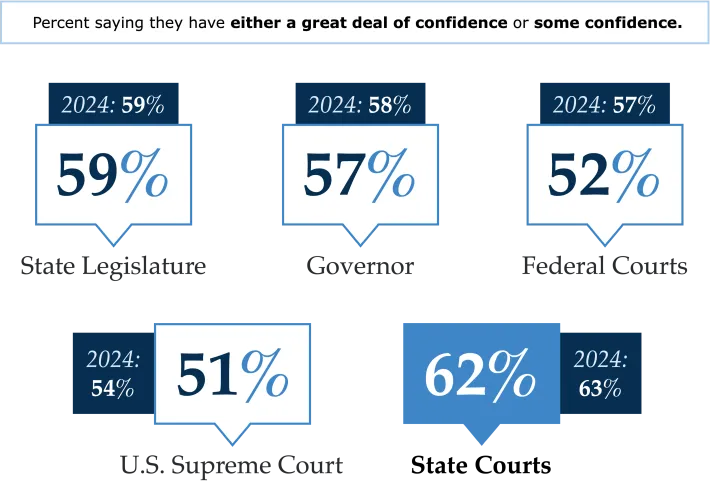
Many key public trust measures are virtually unchanged from one year ago. State courts continue to outperform the other branches of government as well as the federal courts and the U.S. Supreme Court. Courts — especially state courts — remain the most trusted of the three branches of government. This year's survey finds that 62% of respondents express a great deal or some trust in our state court system. Last year's survey placed that number at 63%, and the 2023 figure was 61%, suggesting that public trust in state courts is stable.
Two-tiered system
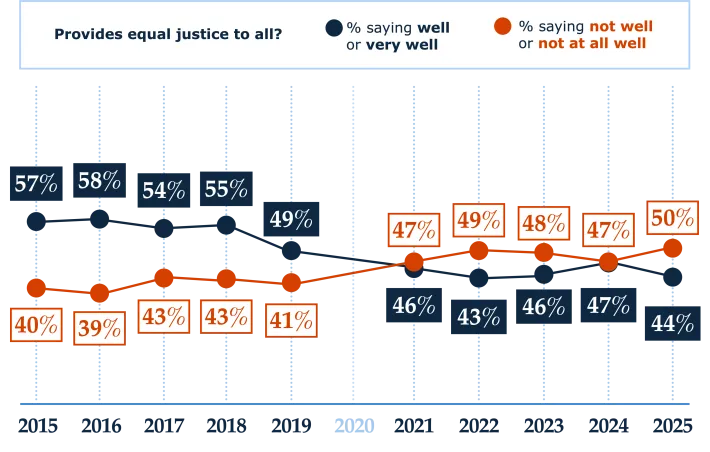
More Americans than ever see a two-tiered system of justice. This has been a measure we have watched carefully over the years. Over the decade we've been conducting this annual survey, we have asked how well state courts provide "equal justice to all." The percentage of Americans agreeing that state courts provide equal justice has slipped from 62% in 2014 to 44% this year. Recent qualitative research has revealed that Americans are concerned that politics, money, racial bias, and the cost and complexity of court all contribute to this trust gap.
The kids are alright
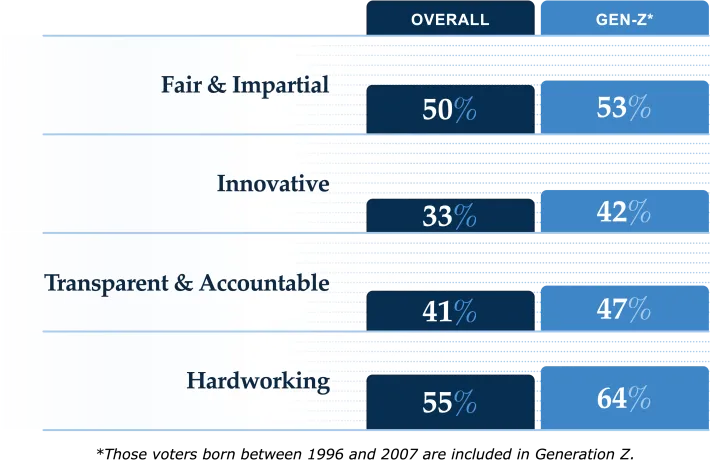
If there is a bright spot in this year's survey data, it is this: younger voters are notably more optimistic about the work of state courts than older ones. The 18-29 age cohort is considerably sunnier in its views of state courts than any other age group. Generation Z voters are three points more likely to agree that state courts are fair and impartial; six points more likely to agree that state courts are transparent and accountable; and nine points more likely to agree that state courts are both innovative and hardworking. It's a nice dose of youthful optimism in our civic polity that is generally sour on all things government.
On AI, the public is glass half empty
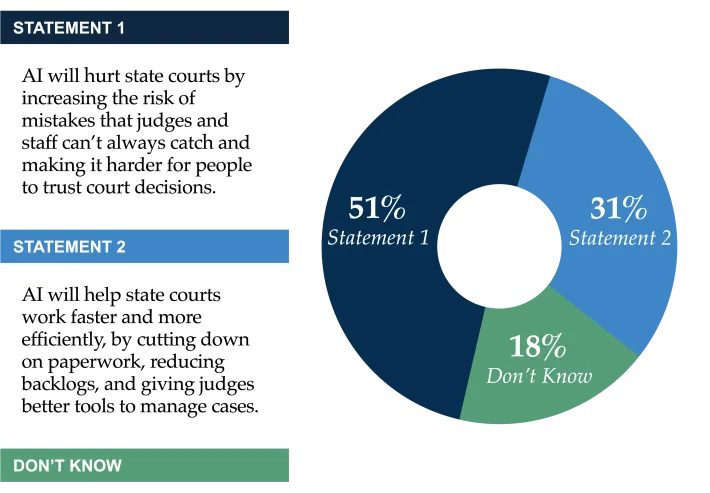
Courts face a daunting challenge in convincing Americans that AI will make the justice system better. As news about fake evidence and hallucinations in briefs and opinions spreads, a majority think that AI will be more harmful than helpful to our courts. This presents courts with both practical and PR challenges as they move to adopt AI responsibly. This finding emphasizes how critical it is for courts to demonstrate leadership on AI. NCSC's work around AI adoption will continue to help courts meet these challenges.
Judicial security
Americans are increasingly concerned about the threat of politically motivated violence against elected officials, judges and other public officials is on the rise, with 50% of those surveyed indicating they think threats have increased in the last 12 months. Federal legislation that would help protect state court judges and court staff has overwhelming public support.
Can legal ed reform improve access concerns?
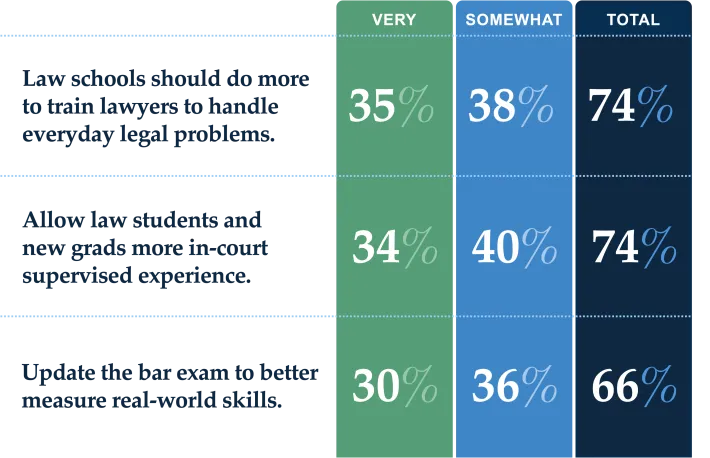
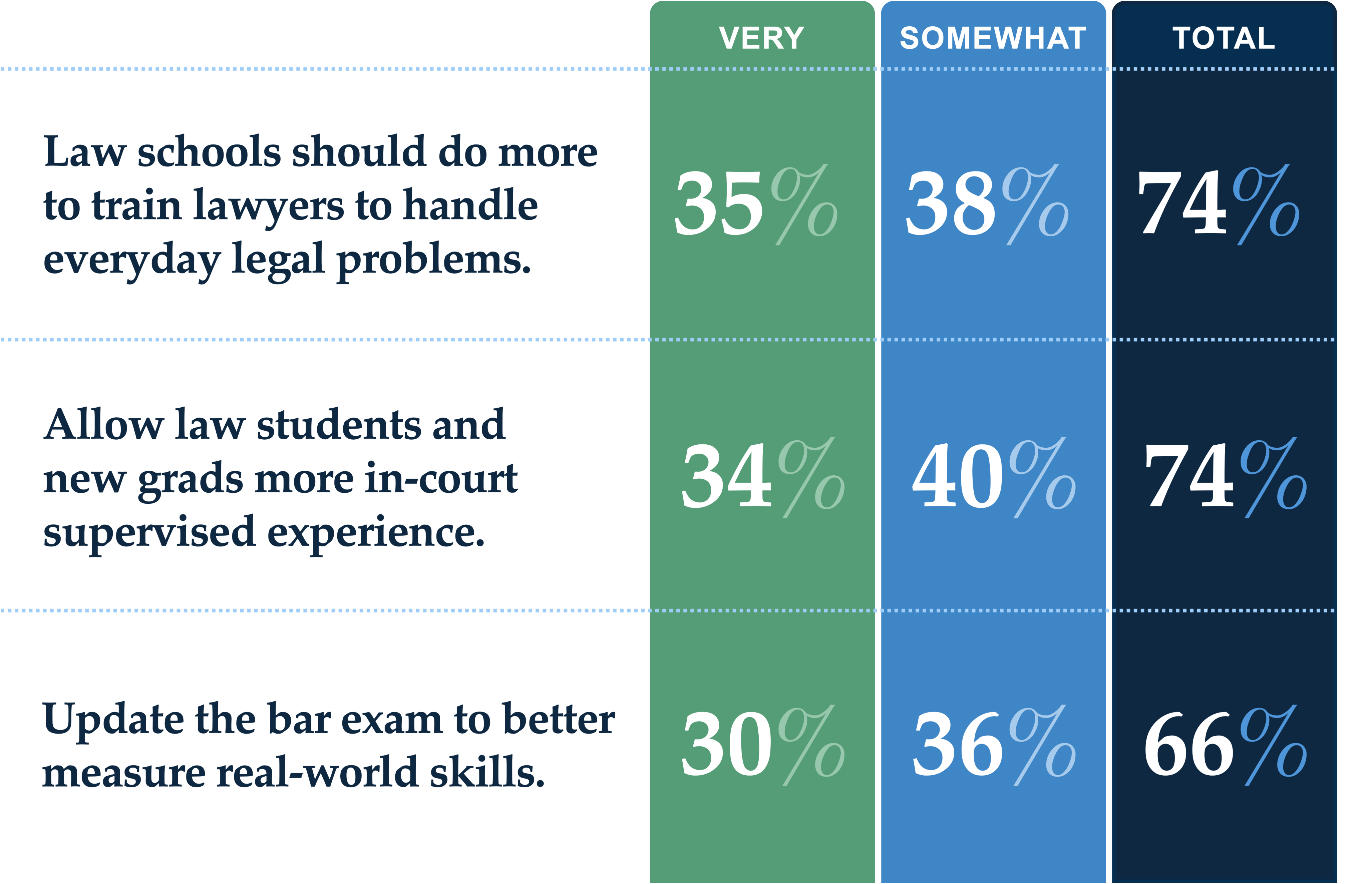
The complexity of court processes and the cost of legal assistance rise to the top of concerns about our access to justice crisis. Most people see reforming legal education as an effective part of the solution. Two-thirds or more believe that legal education reforms like encouraging law schools to do more to train lawyers to handle everyday legal problems, allowing law students and new law graduates more in-court supervised experience, and updating the bar exam to better measure real-world skills would all be effective in helping close the access gap. Read up on the full set of proposed reforms in the eight key recommendations of the CLEAR initiative.
Methodology
NCSC's State of the State Courts public opinion survey uses representative sampling of registered voters. Representative sampling is a statistical method used to select a smaller group from a larger population that mirrors its characteristics, such as age, gender, or socioeconomic status. The goal is to use this smaller, more manageable sample to draw accurate conclusions about the entire population. The sample provides a national snapshot of opinion, but does not allow us to draw conclusions at the level of any individual state.
This year's survey was conducted online between November 12-16, 2025. We surveyed 1,000 registered voters, which provides a margin of error of about 3%, 19 times out of 20.
Discover more public opinion
Explore in-depth findings on public trust, court innovation, and the future of legal services.




Explore more
State of the State Courts: 2024 public opinion poll findings
Our 2024 survey found that public trust is rebounding, and respondents support expanding legal services and using AI tools to improve access.
Trends in state courts
NCSC's annual peer-reviewed report covers the latest advancements in state court administration.
Reports
Explore all NCSC expert reports for court professionals.