

State court caseload trends in 2025: Juvenile
Long-term declines continue
Data reported to the National Center for State Courts' Court Statistics Project (CSP) show that juvenile court caseloads remain substantially below levels observed a decade ago. Both delinquency and dependency filings declined between 2013 and 2025, though the magnitude of the decline differs considerably between the two case types.
Juvenile delinquency filings fell from approximately 489,000 incoming cases in 2013 to roughly 306,000 in 2025, a decline of about 37 percent. Dependency filings also declined during the period, falling from approximately 296,000 incoming cases to approximately 189,000.

View larger image. Reporting states: AL, AK, AZ, AR, CA, CT, DE, FL, ID, IN, KY, LA, ME, MD, MI, MN, NE, NV, NH, NJ, NM, NY, ND, OH, OK, PA, RI, TX, UT, VT, WI.
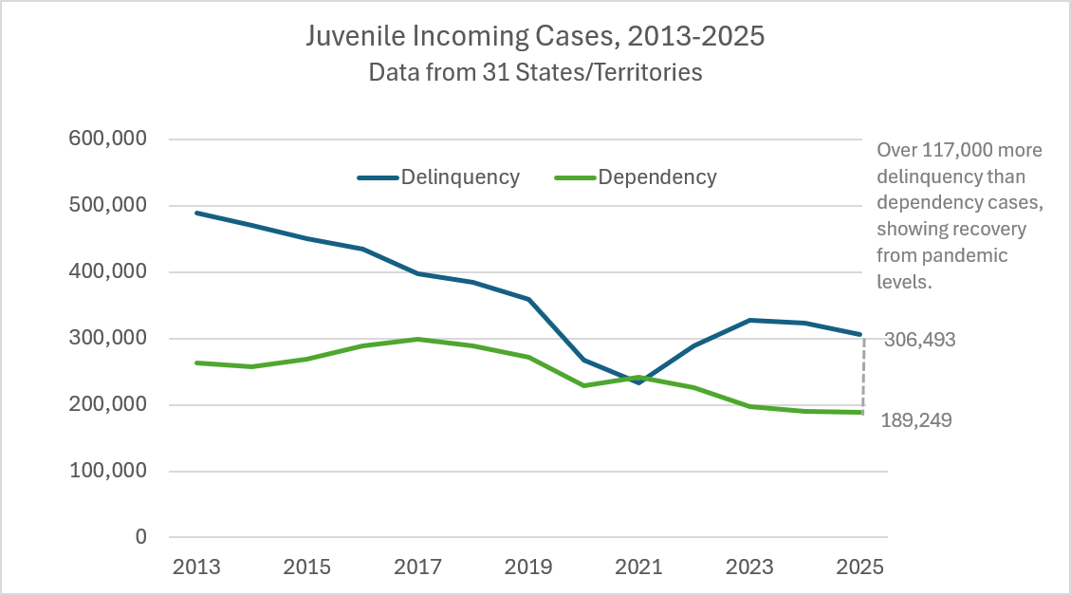
Although both case types declined, delinquency filings continue to outnumber dependency filings in reporting states and territories. In 2025, reporting jurisdictions recorded more than 117,000 additional delinquency filings than dependency filings.
Pandemic disruption & partial recovery
The decline in juvenile filings has not been linear. Delinquency filings decreased steadily through 2020 before rebounding modestly between 2021 and 2024. In 2025, filings again moved downward. Despite the recent rebound, delinquency caseloads remain well below the levels observed before the pandemic and far below those reported a decade ago.
Several factors may have contributed to the sharp decline observed during the pandemic period. School closures likely played an important role because many juvenile referrals originate in schools. As students returned to classrooms and normal activities resumed, juvenile court filings recovered somewhat, though not to pre-pandemic levels.
Dependency filings followed a different pattern. Unlike delinquency cases, dependency filings remained comparatively stable through much of the decade before declining in recent years. As a result, dependency matters now represent a larger share of juvenile court activity than they did 10 years ago.
Consistency with national juvenile justice trends
The decline observed in CSP data is consistent with broader national research documenting reductions in juvenile court involvement over the past several decades. Studies have found long-term declines in juvenile arrests, court referrals, and youth confinement, even as some offense categories experienced temporary increases following the pandemic.1
National estimates published by the National Center for Juvenile Justice (NCJJ) show that total juvenile delinquency cases declined 30 percent between 2014 and 2023. Property offenses, drug offenses, and public-order offenses all experienced particularly large decreases during that period.
At the same time, some offense categories moved in the opposite direction. National estimates from NCJJ show increases in aggravated assault, motor vehicle theft, weapons offenses, and homicide-related cases over portions of the last decade, demonstrating that juvenile crime trends are not uniform across all offense types.
Looking ahead
NCSC's 2025 data reinforce a long-term trend that has reshaped juvenile court workloads across the country. Juvenile courts today process substantially fewer delinquency cases than they did a decade ago, while dependency caseloads have declined more gradually. Together, these trends suggest a continuing shift in the composition of juvenile court work.
Although delinquency filings experienced a modest post-pandemic recovery, current levels remain well below historical norms. Future reporting will help determine whether recent fluctuations reflect short-term changes associated with the pandemic period or the continuation of longer-term patterns in juvenile court involvement.
Explore more
State court caseload trends in 2025: Criminal & civil
Discover clear and consistent 2025 caseload trends across participating states and territories. While criminal filings remain below pre-pandemic levels in many jurisdictions, civil caseloads continue to grow and now substantially exceed criminal filings among reporting courts.
State court caseload trends in 2025: Domestic relations
Data reported by 25 states and territories indicate that domestic relations filings increased in 2025 following a decline in 2024 in a broad range of family-related matters, including divorce, custody, support, paternity, adoption, visitation, and civil protection orders.
Explore court caseload data
We aggregate annual caseload data from states to create this one-of-a-kind resource for understanding the trends shaping our judiciary system.