


State court caseload trends in 2025: Domestic relations
Family-related filings remain below 2021 levels despite recent growth
Domestic relations cases represent a substantial share of state court workloads and encompass a broad range of family-related matters, including divorce, custody, support, paternity, adoption, visitation, and civil protection orders. Under the Court Statistics Project (CSP) reporting framework, these case types are grouped together because they arise from disputes or legal matters involving family members or others in a domestic relationship.
Data reported by 25 states and territories indicate that domestic relations filings increased in 2025 following a decline in 2024. Despite this recent growth, domestic relations caseloads remain below the levels observed in 2021. Among reporting jurisdictions, incoming domestic relations filings increased by 8 percent between 2024 and 2025 but remained 14 percent lower than in 2021.

View larger image. Reporting states: AL, AK, AZ, AR, CT, DC, GA, ID, IN, IA, KY, MI, MN, MO, NE, NM, NY, OR, PR, SC, TN, TX, UT, VT, WI.
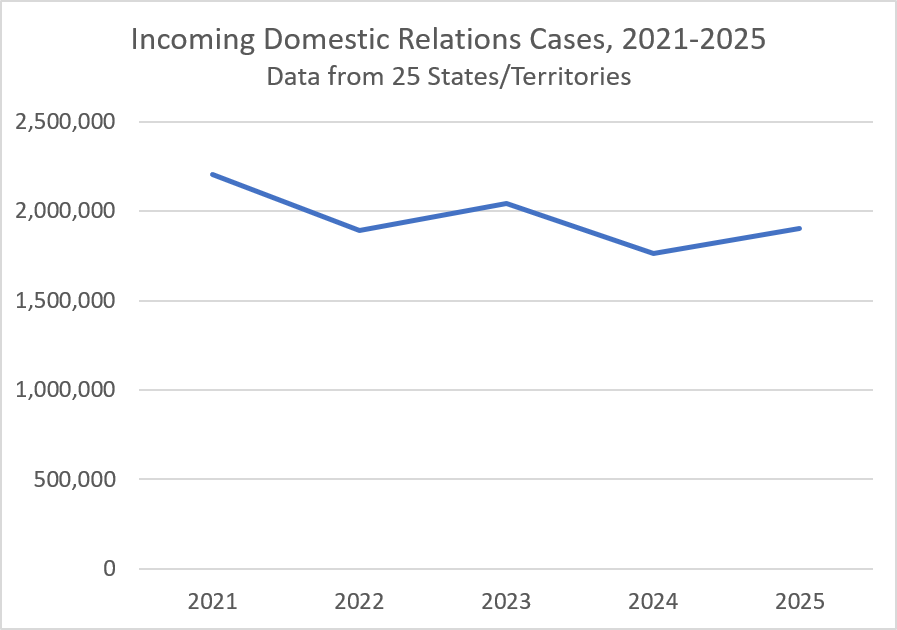
The pattern mirrors trends observed in several other case categories. Court operations were disrupted during the pandemic period, and domestic relations filings have fluctuated in the years that followed. The 2025 increase suggests some renewed growth in family-related court activity, although filing volumes have not returned to earlier levels.
Divorce & dissolution cases remain the largest component of domestic relations caseloads
Among states and territories able to report detailed domestic relations case types, dissolution and divorce cases constitute the largest share of incoming filings. In 2025, approximately 31 percent of domestic relations filings involved divorce, dissolution, separation, or annulment proceedings. Support-related matters accounted for approximately 20 percent of filings, custody disputes accounted for 13 percent, paternity matters comprised 6 percent, and adoption cases accounted for approximately 3 percent. Civil protection and restraining order cases represented approximately 28 percent of filings.
Trend data reported by 24 jurisdictions show that dissolution and divorce filings increased modestly in 2025 compared with the prior year. However, filing levels remained 12 percent below those reported in 2021.

View larger image. Reporting states: AL, AK, AZ, AR, CT, GA, GU, ID, IN, IA, MI, MN, MO, NE, NM, NY, OR, PR, SC, TN, TX, UT, VT, WI.
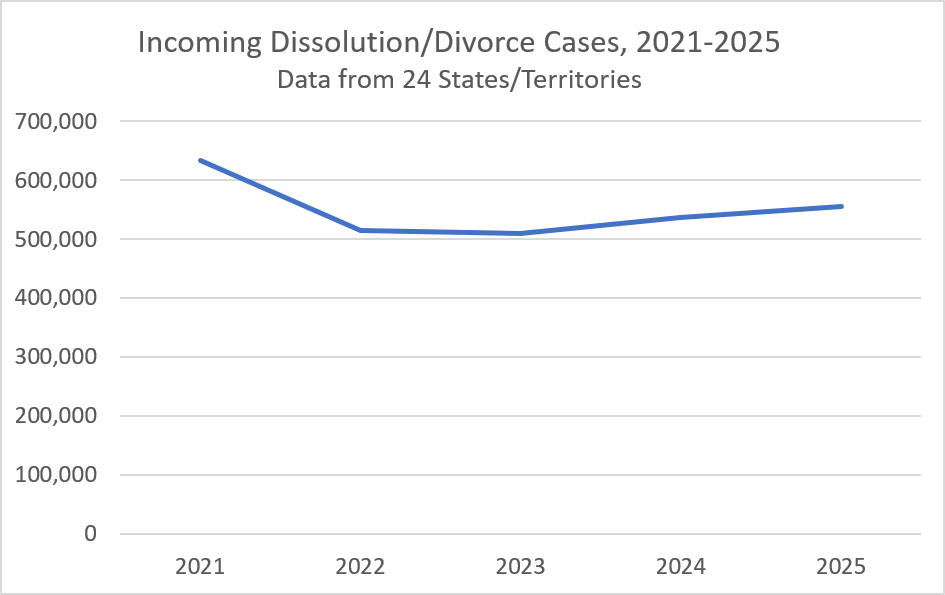
The long-term decline in divorce filings (down 31% since 2012, not shown here) mirrors broader demographic changes documented by researchers, including lower marriage rates, delayed marriage, and changing family formation patterns. While domestic relations courts continue to process large volumes of divorce cases, the category represents a smaller share of overall family-court activity than in previous decades.
Support cases show continued decline
Support-related filings represent another major component of domestic relations caseloads. Under CSP definitions, support cases include matters involving child or family support that are filed independently and are not part of a divorce proceeding. CSP separately distinguishes support cases handled through Title IV-D enforcement programs from support matters initiated privately by litigants.
Among the jurisdictions reporting complete trend data, support filings declined substantially during the 2021-2025 period. Support filings fell 20 percent between 2024 and 2025 and stood 45 percent below 2021 levels.

View larger image. Reporting states: AL, AK, AZ, AR, CT, GA, ID, IN, IA, MI, MN, MO, NE, NM, NY, PR, SC, TX, UT, WI.
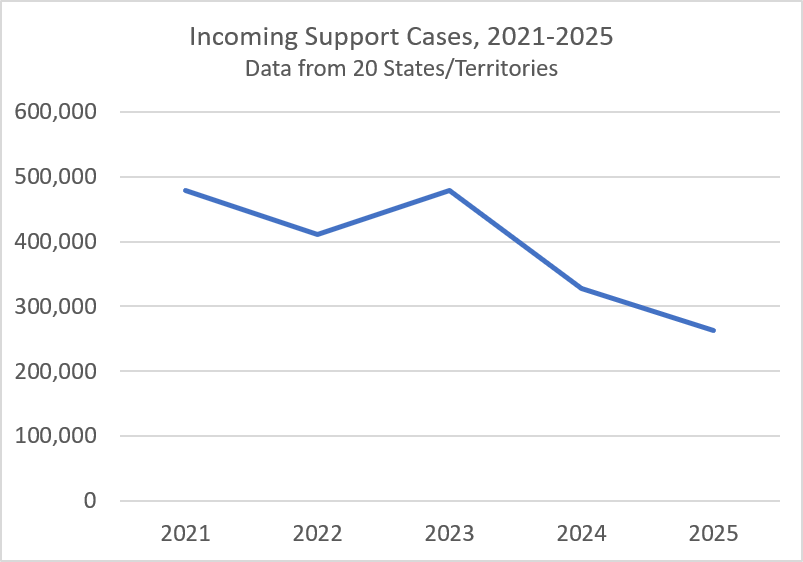
The decline may reflect changing filing practices, greater administrative handling of support matters outside the courts, improvements in automated enforcement processes, or changes in how states classify and report support cases. Additional research would be needed to determine the relative influence of each factor.
State reporting practices influence domestic relations caseload composition
Although national percentages provide a useful overview, the composition of domestic relations caseloads varies significantly across states and territories.
Support matters provide a clear example. In some jurisdictions, support cases constitute a large share of domestic relations filings. Examples include Alabama, Delaware, and Ohio, where support matters account for roughly one-third or more of domestic relations filings. In other jurisdictions, support cases account for a very small share of reported filings.
These differences may arise from variations in court structure, case assignment practices, administrative processing systems, and reporting frameworks. As a result, the most meaningful comparisons often involve examining trends within individual jurisdictions or groups of similarly reporting courts rather than comparing percentages across all states.
Understanding civil protection orders
One of the more significant categories within domestic relations caseloads is civil protection and restraining orders. CSP defines these cases as petitions seeking court orders intended to limit or prevent contact between individuals who are in a domestic relationship.
Comparisons of protection-order filings across states should be interpreted cautiously. Court organization and reporting practices differ considerably among jurisdictions. Some states process and report these matters within domestic relations caseloads, while others may handle related matters within specialized dockets or report certain protection-order proceedings elsewhere in their statistical systems.
In addition, CSP distinguishes domestic relations protection orders from non-domestic restraining orders, which are reported in the civil case category rather than the domestic relations category.
Because of these structural differences, national trend analyses for protection-order filings remain challenging despite the importance of the case type.
Looking ahead
The 2025 data suggest that domestic relations caseloads are experiencing modest recovery in the past year. Overall filings increased in 2025, but domestic relations courts continue to receive fewer incoming cases than they did in 2021. Divorce and dissolution cases remain the largest identifiable component of domestic relations workloads, while support filings have declined substantially in recent years.
The data also highlight the increasingly diverse nature of domestic relations court work. In addition to divorce, custody, support, and adoption matters, courts process a substantial volume of civil protection order cases and other family-related proceedings. Understanding how these different case types evolve over time will remain important for court leaders responsible for allocating resources, designing court services, and responding to the changing needs of families.
Explore more
State court caseload trends in 2025: Criminal & civil
Discover clear and consistent 2025 caseload trends across participating states and territories. While criminal filings remain below pre-pandemic levels in many jurisdictions, civil caseloads continue to grow and now substantially exceed criminal filings among reporting courts.
Early data signals increased civil filings, decreased clearance rates in 2025
Early 2025 caseload data reveal a continuing shift in the composition of state court workloads. For the fourth consecutive year, civil filings are growing faster than criminal filings, widening a trend that first emerged as courts recovered from pandemic-era disruptions. At the same time, courts may be seeing the first signs of a slowing post-pandemic recovery, as clearance rates decline after several years of improvement.
State court caseload trends in 2025: Juvenile
Data reported to the National Center for State Courts' Court Statistics Project (CSP) show that juvenile court caseloads remain substantially below levels observed a decade ago.