


State court caseload trends in 2025: Criminal & civil
Executive summary
The latest 2025 caseload data submitted to the National Center for State Courts' Court Statistics Project (CSP) reveal several clear and consistent trends across participating states and territories. While criminal filings remain below pre-pandemic levels in many jurisdictions, civil caseloads continue to grow and now substantially exceed criminal filings among reporting courts. The changing composition of court workloads represents one of the most significant developments in state court operations during the post-pandemic period.
At the same time, growth in civil filings is not occurring uniformly across all case categories. Instead, the increase is concentrated in a relatively small number of case types, particularly contract disputes, small claims matters, and debt collection-related litigation. These filings account for much of the growth observed among participating states and territories.
The findings presented here reflect final 2025 reporting currently available to CSP and provide a broader picture than the preliminary data released earlier in the year.
Civil caseloads continue to outpace criminal filings
Over the last several years, courts have experienced a gradual shift in the balance of incoming case activity. Criminal filings declined sharply during the pandemic and have recovered only modestly in many jurisdictions. Civil filings, by contrast, have shown sustained growth.

View larger image. States reporting: AK, AZ, CA, CO, CT, FL, IN, IA, KY, LA, ME, MD, MA, MI, MN, MO, NE, NV, NH, NJ, NY, ND, OH, TN, TX, UT, WI, WY.
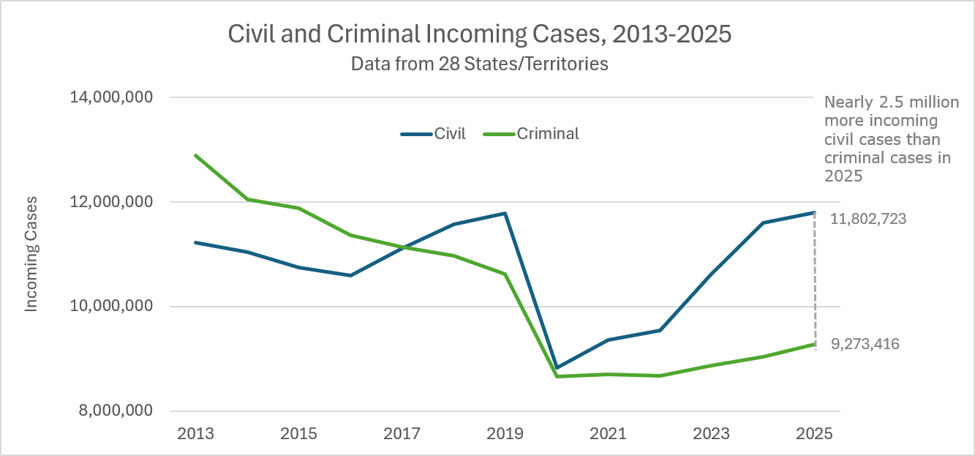
Data from 28 states and territories indicate that this shift continued through 2025. Civil filings exceeded criminal filings by nearly 2.5 million cases among reporting jurisdictions. While both civil and criminal case volumes remained relatively stable compared with the preliminary findings released earlier this year, the overall pattern remains clear: civil matters account for an increasingly large share of court workloads.
This trend suggests that court leaders should continue to focus not only on overall filing volumes, but also on changes in the types of cases entering courts and the operational demands associated with those workloads.
Clearance rates suggest continuing capacity pressures
Although courts have made substantial progress in addressing pandemic-era backlogs, clearance rates indicate that maintaining those gains may become increasingly challenging. Among reporting jurisdictions, criminal clearance rates remained relatively stable through 2025, while civil clearance rates continued a gradual decline.
Civil clearance rates fell to approximately 91 percent in 2025, compared with roughly 95 percent in 2021. Criminal clearance rates remained closer to parity, approaching 96 percent in 2025.

View larger image. States reporting: AL, AK, AZ, AR, CA, CT, DC, FL, GA, IL, IN, IA, KY, LA, MD, MI, MN, MO, NE, NV, NH, NJ, NM, NY, ND, MP, OH, OR, PA, PR, RI, SC, TN, TX, UT, VT, VA, WI.
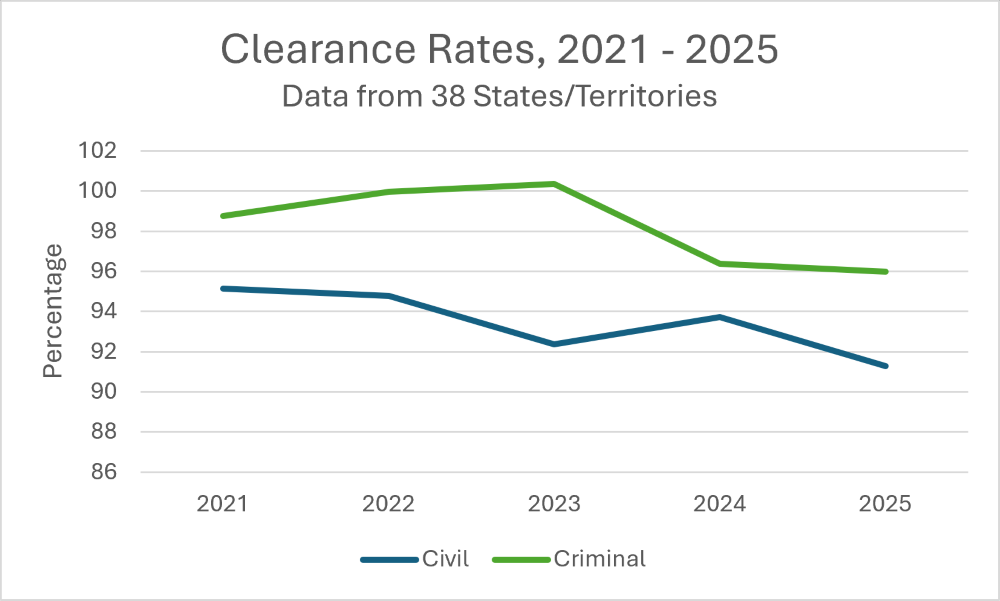
These figures do not necessarily indicate a return to significant backlogs. However, they suggest that incoming civil workloads may be growing faster than many courts' ability to resolve cases. Continued monitoring will be important to determine whether this represents a temporary fluctuation or an emerging long-term challenge.
The civil story is primarily a contract story
The most important development within civil caseloads is not broad-based growth across all forms of litigation. Instead, the increase is concentrated in a handful of case categories. Data reported by 40 states and territories show that contract filings have grown substantially since 2021 and account for most of the increase in incoming civil cases.
Small claims filings have also increased, though less dramatically than contract filings. In contrast, tort filings have remained comparatively stable throughout the period.

View larger image. States reporting: AL, AK, AZ, AR, CO, CT, DE, DC, FL, GA, ID, IN, IA, KY, ME, MA, MI, MN, MS, MO, NE, NV, NH, NJ, NM, NY, NC, ND, MP, OH, OR, PA, PR, RI, SC, TX, UT, VT, WI, WY.
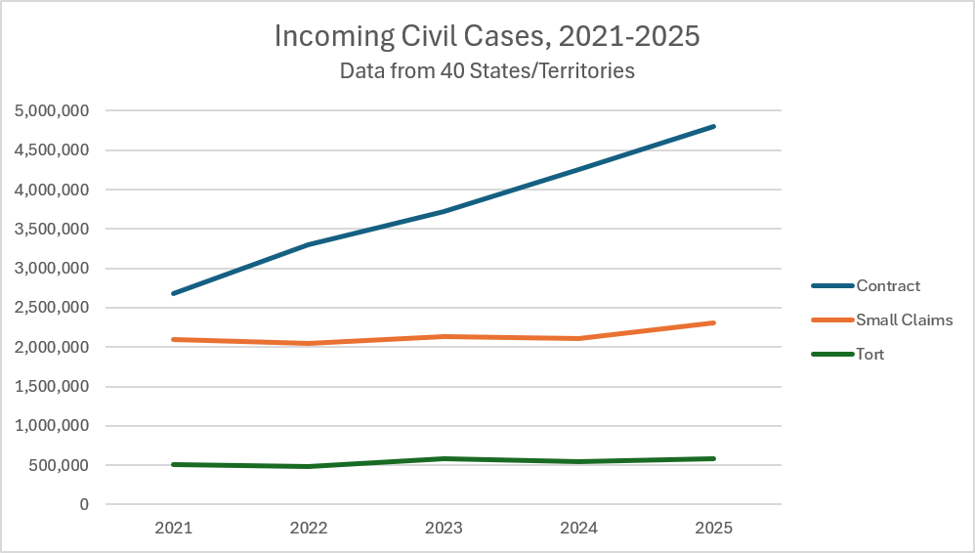
The pattern suggests that courts are not experiencing a broad expansion of traditional civil litigation. Rather, growth is concentrated in case types involving financial obligations, consumer disputes, collections activity, and lower-dollar claims. These case categories often require high-volume processing approaches that differ from those associated with more complex civil litigation.
For court administrators, the distinction matters. Case management strategies, staffing models, technology investments, and self-service resources may need to evolve to address growing volumes of financially driven filings.
Seller-plaintiff cases are driving contract growth
A closer examination of contract filings provides additional insight into the source of recent civil growth. Among the jurisdictions reporting detailed contract case categories, seller-plaintiff filings experienced the most substantial increase between 2021 and 2025.
Landlord-tenant filings rose significantly following the pandemic and have remained elevated, but recent growth appears relatively stable. Mortgage foreclosure filings increased modestly but remain small compared with other contract-related categories.
Seller-plaintiff filings, which frequently include debt collection and creditor actions, account for much of the observed increase in contract caseloads. Combined with growth in small claims filings, the data point toward a consistent theme: courts are seeing increasing demand associated with financial disputes and collection-related litigation.

View larger image. States reporting: AL, AK, AZ, AR, CO, CT, IN, IA, ME, MD, MA, MO, NV, NH, NY, MP, PA, RI, UT, VT.
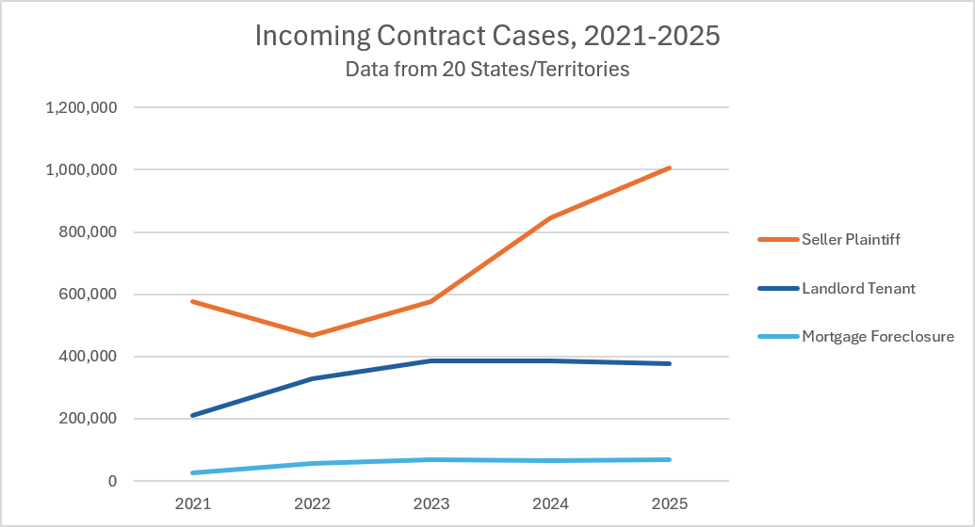
This trend has important implications for access to justice, case processing efficiency, and the design of court services intended to support large numbers of self-represented litigants.
Looking ahead
The 2025 data reinforce a trend that has been emerging for several years. Civil filings continue to grow relative to criminal filings, and much of that growth is concentrated in financially driven disputes rather than across the full spectrum of civil litigation. Clearance rates suggest that some courts may be approaching capacity constraints, particularly within civil dockets.
As courts continue adapting to changing caseload patterns, understanding not only how many cases are being filed, but also what types of cases are entering the system, will remain critical for workforce planning, technology investments, procedural reform efforts, and the effective administration of justice.
Companion analyses of juvenile and domestic relations caseloads will be released separately as part of the 2025 CSP Trends Series.
Explore more
Early data signals increased civil filings, decreased clearance rates in 2025
Early 2025 caseload data reveal a continuing shift in the composition of state court workloads. For the fourth consecutive year, civil filings are growing faster than criminal filings, widening a trend that first emerged as courts recovered from pandemic-era disruptions. At the same time, courts may be seeing the first signs of a slowing post-pandemic recovery, as clearance rates decline after several years of improvement.
State court caseload trends in 2025: Juvenile
Data reported to the National Center for State Courts' Court Statistics Project (CSP) show that juvenile court caseloads remain substantially below levels observed a decade ago.
State court caseload trends in 2025: Domestic relations
Data reported by 25 states and territories indicate that domestic relations filings increased in 2025 following a decline in 2024 in a broad range of family-related matters, including divorce, custody, support, paternity, adoption, visitation, and civil protection orders.